Description
Amplifier Research 100S1G6 RF Amplifier, 0.7 to 6 GHz, 100W
-
- Provides a minimum of 100 watts of RF power when used with a sweep generator
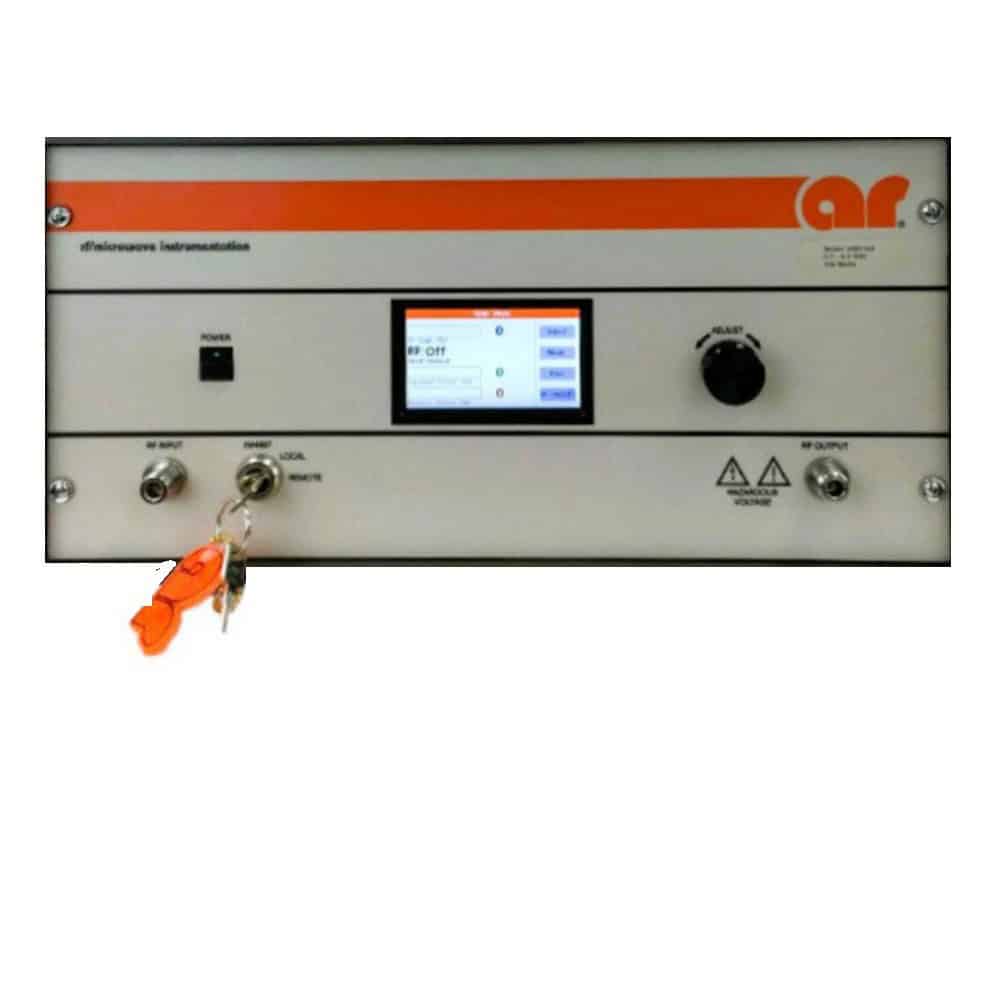
- Front panel gain control provides convenience of setting desired output level
- RF input leveling circuit:
- Protects the amplifier from RF input overdrive
- Controls RF input level to the RF amplifier first stage when RF input level is increased above 0 dBm
- RF amplifier stages are protected from over-temperature, due to cooling blockage or fan failure, by removing the DC voltage to them
- Digital Display on front panel indicates operate status and fault conditions when over-temperature or power supply fault occurs
- Control functions and status indications are available remotely in GPIB/IEEE format, RS-232 hardwire and fiber optic, USB and Ethernet
- Bus interface connector on back panel
- Local/Remote switch on front panel assures positive control of local or remote operation
- Low level of spurious signals and linearity make it ideal for these uses:
- As a driver amplifier in testing wireless and communication components and subsystems
- As a test instrument covering mutiple frequency bands
- For communication technologies including CDMA, W-CDMA, TDMA, GSM, etc.
- Specifications:
- Rated output power: 100 watts minimum
- Input for rated output: 1.0 milliwatt maximum
- Power output @ 3dB compression:
- Nominal: 120 watts
- Minimum: 100 watts
- Power output @ 1dB compression:
- Nominal: 100 watts
- Minimum: 80 watts
- Small Signal Gain Flatness:
- typical: ±1.5 dB
- maximum: ±2.5 dB
- Frequency response: 0.7 – 6 GHz instantaneously
- Gain (at maximum setting): 52 dB minimum
- Gain adjustment (continuous range): 10 dB minimum (4096 steps remote)
- Input impedance: 50 ohms, VSWR 2.0:1 maximum
- Output impedance: 50 ohms nominal
- Mismatch tolerance:
- 100% of rated power without foldback
- Will operate without damage or oscillation with any magnitude and phase of source and load impedance
- Modulation capability: Will faithfully reproduce AM, FM, or pulse modulation appearing on the input signal